
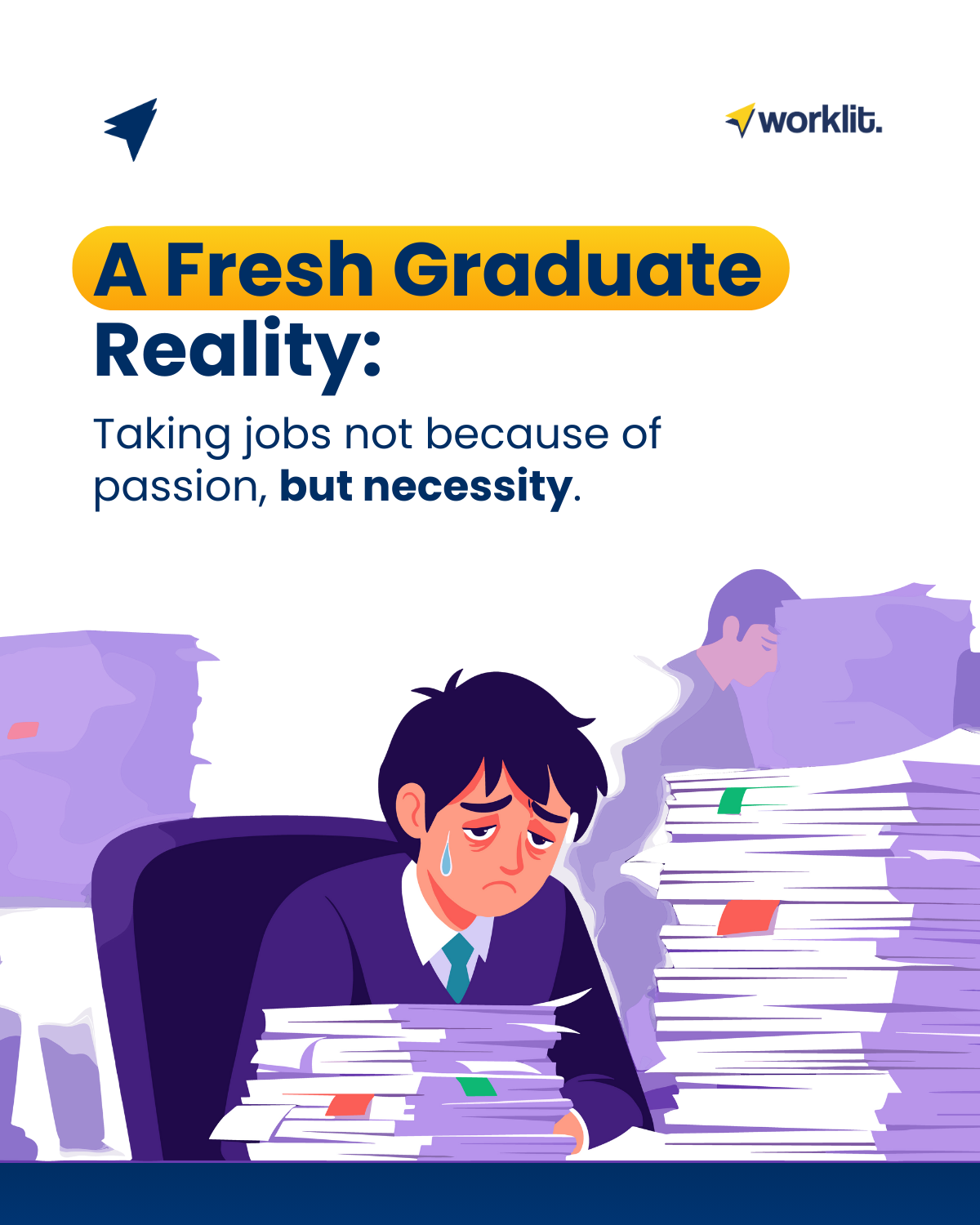
Not all fresh graduates have the privilege to choose their jobs. Sometimes it’s all about accepting what’s in front of their eyes. A survival mode of “to get a job first with any position”. With the economic pressure, family demands, installments, and the “have to work fast” culture, many fresh graduates take any job that has a vacancy. According to a 2024 survey by the Katadata Insight Center, 43% of fresh graduates felt lost after graduation. Many were torn between continuing their studies, starting a business, or going straight into employment. This shows that survival mode is pretty much a common phenomenon for fresh graduates. A survival mode is a mental battle and that doesn’t make them any less ambitious. It just means that they’re struggling. Then what do they have to do? Emergency options can be a starting point for discovering a new passion or skill. Start a business for an example, you could learn about problem solving, rapid adaptation, mental toughness, communication, and customer handling. Truthfully, any work experience can build soft skills as communication, resilience, adaptability, and discipline. Career paths often change. Many people discover their passion after trying something they weren’t originally interested in.
What Are The Signs That You Are Job Hugging Without Realizing It?
There are so many ways to deny that you’re in a worst mental and physical state but you feel like you shouldn’t feel like that because you get paid well. Are you truly happy at work… or are you just job hugging? What is job hugging exactly? Job hugging is a condition where you stay at a job not because you like it, but because you’re afraid of starting over a new one. It’s like saying you’ll find a better job in the future but you’re not looking for one either. According to CNBC Indonesia, recent data shows that the job-to-unemployment ratio in the US has fallen from 2:1 in March 2022 to approximately 1:1 in June 2025. This shows that workers who stay too long risk missing out on salary increases, as history shows that workers who move on typically receive larger pay raises than those who remain in their previous positions. Furthermore, becoming too comfortable can lead to worker stagnation and underdevelopment. Ultimately, workers become less competitive when the labor market rebounds. That’s the thing about job hugging, you settle for less. You’re no longer growing because you’re terrified of starting over, even though you’re not truly happy working in your current company. Job hugging can also means you stay because you’re comfortable with the team, not because the job is a good fit. You use “stability” as an excuse when you’re actually afraid to explore. Does that mean you’re loyal to your company? No. There’s a difference between loyalty and a ‘fear of moving’, awareness, and later decisions. If you’re loyal then why aren’t you happy working in your current company? Job hugging sometimes does feel natural, but it’s important to know whether your decision is based on fear or growth. Which sign do you relate to?
Taking Internships After Graduation? No Problem!
Interning after graduation isn’t a sign of failure. Sometimes, before entering the professional world, you need a warm-up to improve your performance. Freshgraduates need to start seeing internships as a strategy, not just a learning phase, but an opportunity for you to take every step steadily to reach your career. Many people think that an internship after graduation is a waste of time. In fact, it can be a career-accelerating step. Who knows you will get an opportunity to be a full-timer in the company you’re applying for internships? Still, there is no guarantee that you will be given a permanent job after the internship. But… what are the challenges of taking internships after graduation? Companies will give you bigger expectations and responsibility. So the phenomenon of an intern having responsibilities that are similar to a full timer is actually pretty common and a no-wonder thought. Then what is the right choice? Those who want to gain work experience and build a network, an internship might be the right choice. Those who need a stable income and want to advance your career, looking for a permanent job right away might be better. There’s no right or wrong answer. For freshgraduates who’s reading this right now, before you decide, ask yourself: What do I need the most right now? Because the most important thing is to choose the option that best suits your needs and goals.
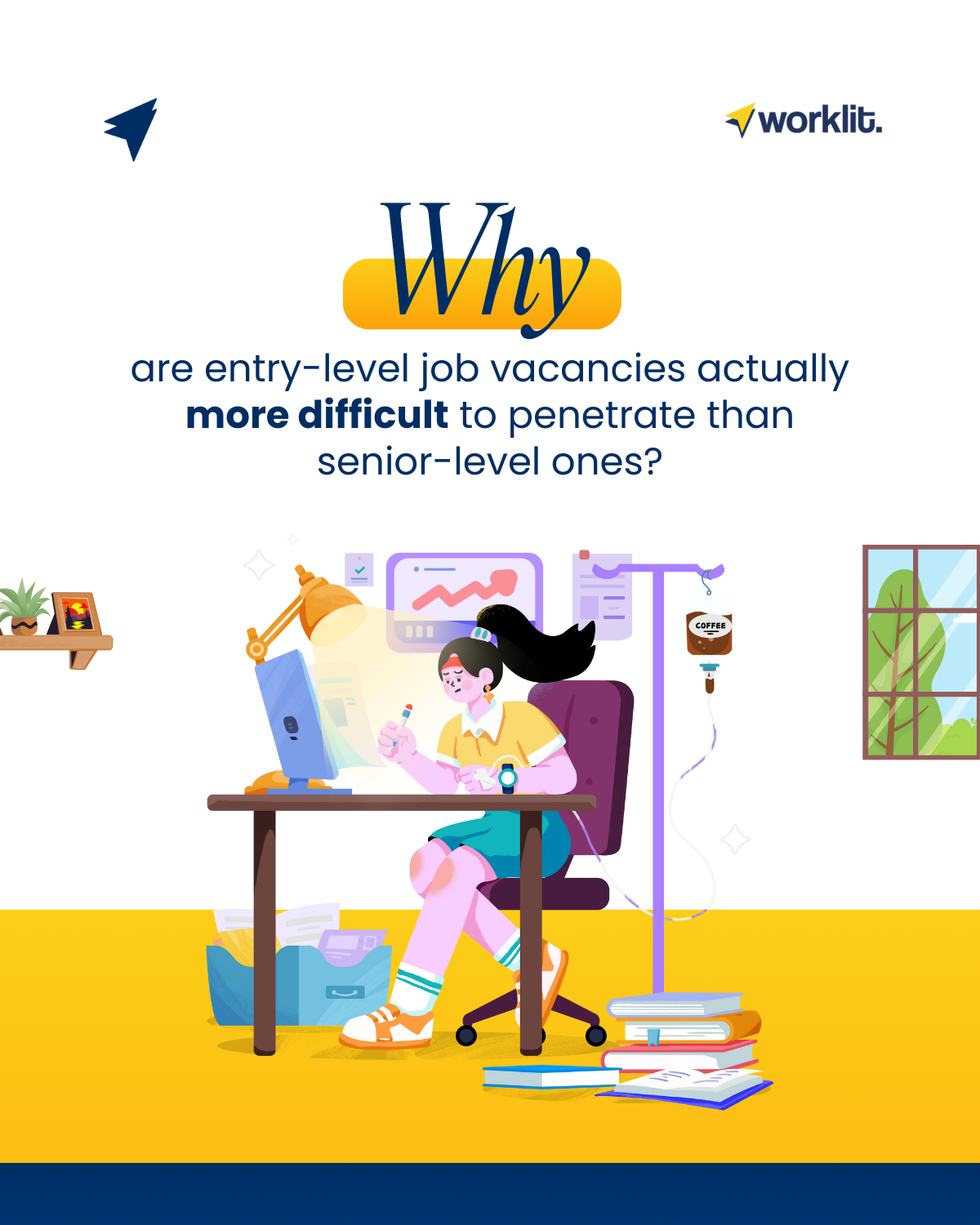
Why are entry-level job vacancies actually more difficult to penetrate than senior-level ones?
Have you ever wondered why entry-level positions are so hard to get? Even though the people applying are “all newbies.” The answer is simple. Entry-level positions aren’t the easiest because the competitors are not hundreds… but thousands. That’s what makes entry-level job vacancies are highly competitive. From thousands of applicants, skill gaps, CV screenings, to companies being super selective because these are the foundational positions of their teams. Many applicants have no proof of ability, only theory. On the other hand, C-level candidates are few, but all are proven. According to Kompas, using LinkedIn data, the BBC found that of nearly 4 million US job postings since the end of 2017, 35 percent were for entry-level positions, but also required years of relevant work experience. This shows narrows access for budding talent and takes more of their time transitioning from education to the professional world. Ultimately, competition at the entry-level level becomes much fiercer than for mid- to C-level positions. Even the recruitment process is also different, so the process is much more strict for entry-level where recruitment focuses more on leadership qualities and track record, rather than a rigid number of years of experience. Then what should fresh graduates do? They need to start targeting companies that opens for fresh graduates, startups that need fast learners, MT/ODP programs as a fast-track route. Instead of applying to 100, it’s better to apply to 20 relevant and complete applications. For fresh graduates who are reading this give up yet, entry-level isn’t impossible, it just requires the right strategy.
Not Just About The Money, Here’s Why Many Indonesian Workers Go Abroad
Why do so many Indonesians prefer to work abroad rather than in their own country? For some fields, salaries abroad can be many times higher than in Indonesia. Not only is it tempting, but it’s sometimes more than adequate for similar workloads. But the truth is, it is not just about the salaries they earn. Then what are other factors? According to Kontan.co.id, the number of Indonesian migrant workers (PMI) working abroad is very large, reaching more than 5.2 million people according to the latest data. This high number reflects not only the strong demand for Indonesian workers abroad but also a shift in preferences driven by better working conditions. Many Indonesians choose overseas employment because they find a level of structure and protection that is often lacking at their country. From health insurance, paid leave, clear contracts, to legally protected working hours, many workers feel their rights are better respected. These are the other factors that many indonesians workers go abroad. Remembering Indonesia’s economy and job market at worst, massive lay-offs, low wages, and skill mismatches. Many indonesians feel stuck with their career. In the end, they think working abroad might be more “reasonable” option. Not simply to join “follow the crowd” phenomenon, but because of economic factors, benefits, career opportunities, and a better work environment. What do you think? Is working abroad a choice or a necessity these days?
Under-Guaranteed Company Benefits: The Impact Is Bigger Than You Think
Imagine you put yourself into this position in which the salary is okay, the workplace culture is good,but the company’s benefit… not really worth it. This is why jobseekers need to think twice about the company’s benefit before signing contract. According to Glassdoor’s economic research, 51% of professionals are dissatisfied with their benefits package, and only 30% of employees are satisfied, and 19% are unsure. When companies offer good benefits, employees not only feel valued but also more engaged in their work. From insurance and pension plans to various other perks that make their lives more secure have a significant impact. This is why companies need to be serious about providing competitive benefits to retain top talent. Today’s company common problems are minimal benefit for their employees, such as no health insurance, no leave, no THR, etc. In short term impact, employees have to pay for all their healthcare with no job security guaranteed, no leave entitlement guaranteed, and work risks are borne personally. What about long term impact? Employees can experience long-term financial loss, with no work accident protection and no social stability and secure future. Why the impact is bigger than you think? Benefits are not bonuses. Benefits are basic protection that companies are required to provide. Here’s what you can check to be more aware on company’s benefit before signing a contract: Minimal benefits aren’t just about inconvenience, it’s about workers’ safety, risk, and future.

